Security research · learning tool
MetroCrackin
A hands-on study of why slow password hashing matters
A .NET command-line project, the sibling to MetroBoomin, for understanding how credentials are stored and why the way you hash them makes or breaks their safety. Run only against test data we generate.
The challenge
"Just hash the password" hides a lot. The difference between a fast hash and a slow, salted one is the difference between credentials that survive a breach and credentials that don't.
The approach
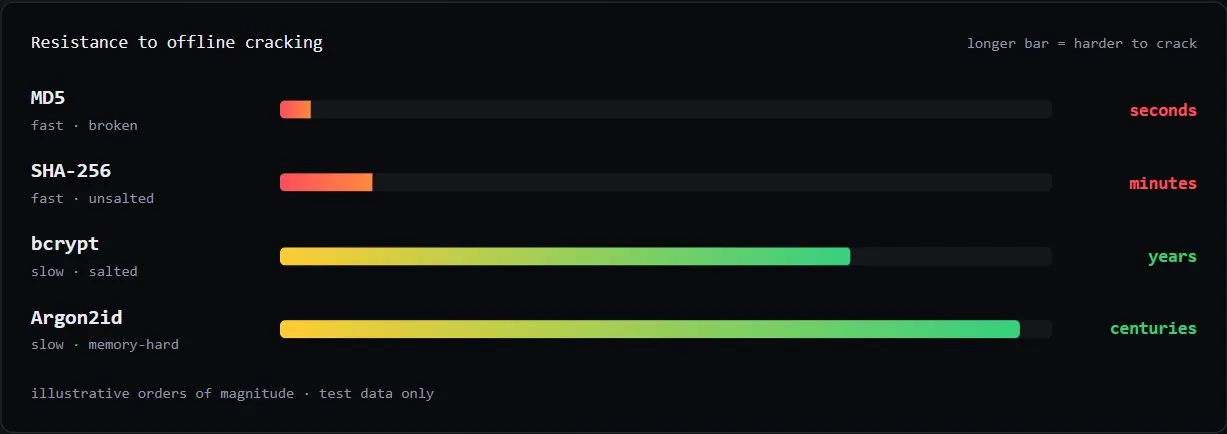
A console tool that works entirely against self-generated test data to show, concretely, how quickly weak hashing falls and why modern, deliberately-slow password hashing holds up — the reasoning behind how we store credentials in client work.
Features
- Fast vs slow hashing: Shows in practice why a general-purpose fast hash is the wrong tool for storing passwords.
- Salting and work factors: Demonstrates what salts and tunable work factors actually buy you.
- Test data only: Runs exclusively against credentials we generate ourselves, never real ones.
- Feeds real decisions: The takeaways are exactly how we choose password hashing for the apps we ship.
- Side-by-side benchmarks: Algorithms are timed against each other on the same machine, so the differences are measured rather than assumed.
- Plain-English results: Each run ends with a summary of what the numbers mean for choosing a password-hashing approach.
Outcomes
- Measured why slow, salted password hashes are the right default
- Directly shaped how passwords are stored in the apps we build
Built with
- C#
- .NET 8
- Console